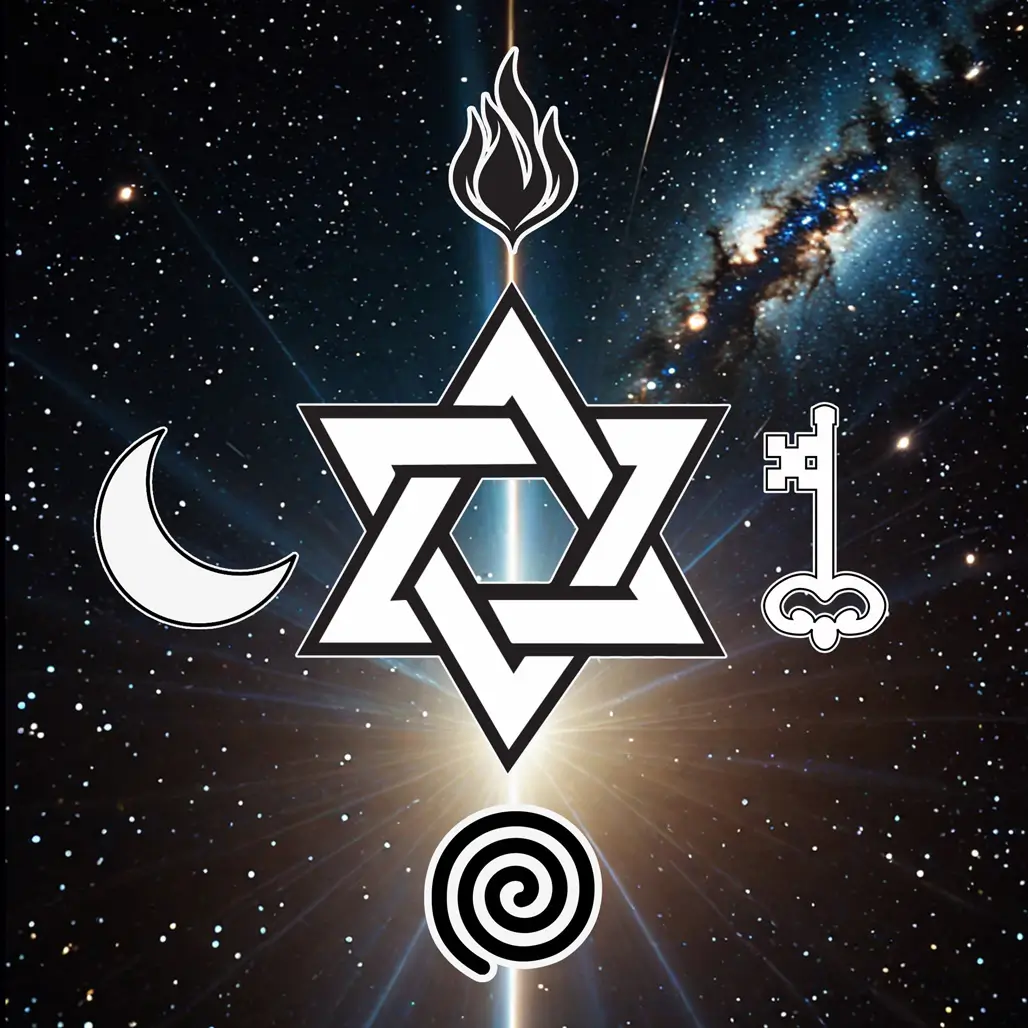
Primordial Steward of Liminality
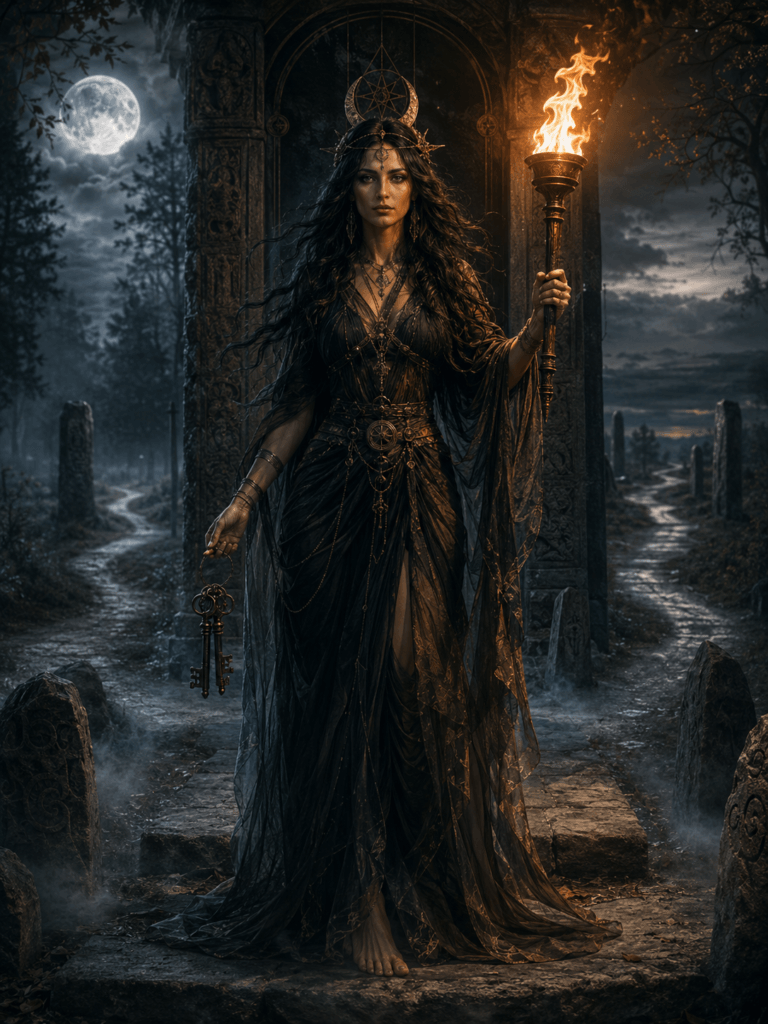
Some mysteries cannot be approached all at once. They call us nearer slowly, as veil after veil is lifted, through symbol, intuition, image, and the quiet recognition of something we felt long before we knew how to name it. The goddess Hekate has become such a mystery for me. Though she is known by many ancient and modern titles, I have come to understand her most deeply in the charged stillness of the threshold.
There was darkness before form.
There was the first stirring inside the Void.
There was the instant before light became light, before matter took shape, before breath entered the body, before one state of being yielded to another.
That is where I have come to understand Hekate.
Not merely as a goddess within myth, though myth preserves traces of her. Not only as a figure of magic, though magic belongs naturally to her field. Not simply as a guide of witches, spirits, crossroads, keys, and torches, though these remain part of her living iconography. I have come to understand Hekate as something older, deeper, and more vast: a primordial intelligence of liminality itself.
Liminality is the condition of being between.
It is the doorway, not yet crossed.
It is the old life loosening its hold before the new life has appeared.
It is the hush before a confession. The silence after loss. The restless night before a decision. The strange, charged pause when we know we cannot remain who we were, but do not yet know who we are becoming.
Liminality is woven into existence. Dawn and dusk are liminal. Birth and death are liminal. Grief, love, illness, healing, exile, return, awakening, desire, forgiveness, and surrender all carry us through threshold states. Every act of becoming requires us to stand, for a while, where certainty fails.
This is Hekate’s domain.
She is present wherever a boundary softens, wherever an old form breaks open, wherever consciousness enters the dark passage between what has ended and what has not yet begun.
Many people first meet Hekate through her familiar titles: goddess of witchcraft, magic, ghosts, night, moon, crossroads, keys, and torches. These titles are not wrong. They are simply incomplete. They name the signs around her, not the whole of her being.
Witchcraft belongs to her because witchcraft works at the edges of things. It listens where the seen touches the unseen. It honors herbs, bones, smoke, flame, moonlight, dreams, and spoken will as bridges between worlds. Yet Hekate is not contained by witchcraft. It is one way human beings have approached her. It is not the boundary of her nature.
Her deeper nature is threshold.
Her older name is change.
Her truest movement is becoming.
In ancient memory, Hekate stands before the Olympian order. She is linked with the Titans, with old powers, with the strata of divinity that belonged to the world before the later gods took their more polished forms. Some traditions place her roots in regions beyond Greece, including Anatolia and Thrace, where earth, wildness, night, animals, fertility, death, and protection often lived close together in sacred imagination. This older Hekate does not feel like a minor figure added to the edge of a pantheon. She feels like a surviving face of something far more primal.
She belongs to the crossroads because crossroads are places of choice.
She carries keys because keys open what has been locked.
She carries torches because the passage into change often begins in darkness.
She is linked with thresholds because every threshold asks for courage.
She stands in the night because the hidden self is easier to hear when the world grows quiet.
These symbols are not decorations. They are teachings.
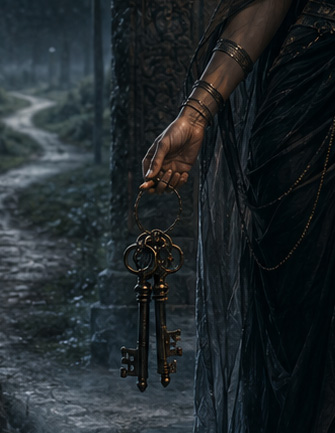
The key is not merely an object in her hand. It is the symbol of access. It tells us there are doors within us we have not opened. Some lead to memory. Some lead to grief. Some lead to gifts we buried to survive. Some lead to power we fear because we know it will change our lives.
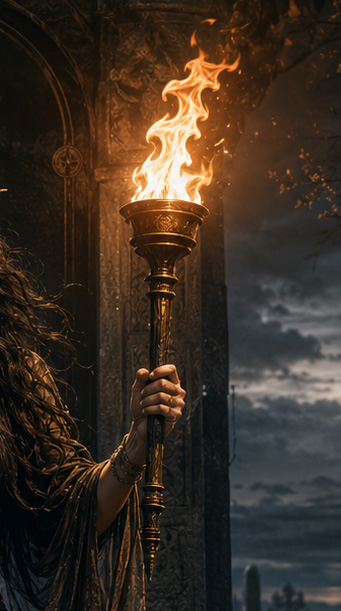
The torch is not merely a flame. It is the light needed for descent. Hekate does not remove the dark. She illumines enough of it for us to walk.
That distinction matters.
She does not promise a painless path. She does not flatten mystery into comfort. Her light reveals roots, stones, bones, tracks in the mud, the face of the wolf watching from the tree line. It shows us where we are, not where we pretend to be.
The crossroads are not merely three roads meeting in the night. They are the lived moment of decision. Stay or go. Speak or remain silent. Grieve or harden. Heal or repeat. Trust the call or retreat into the known. Every human life contains these crossings. Some arrive loudly, through crisis. Others appear quietly, as a faint unease that grows until we can no longer ignore it.
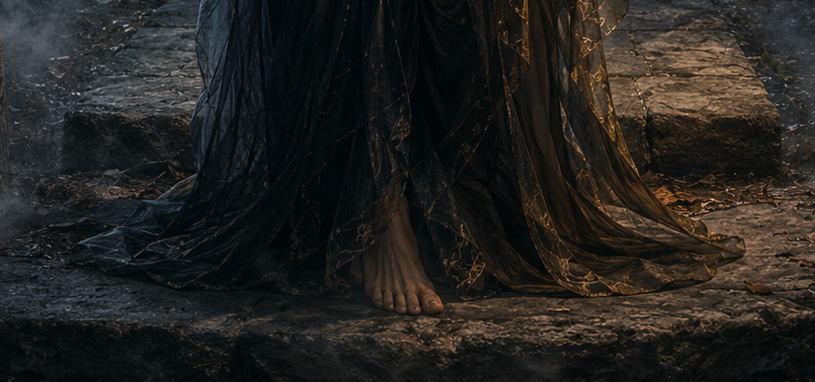
The threshold is the most intimate of her symbols. A threshold is neither one room nor the next. It is the strip of passage between them. To stand there is to be held in suspension. This is why thresholds can feel sacred, fearful, charged, and strange. The self does not like to dissolve. The ego does not enjoy uncertainty. Yet the soul grows through these crossings.
My own revelation of Hekate came through this understanding.
I did not first come to her through a desire to adopt a religious devotion, nor through a wish to dress her in borrowed drama. I found her, or perhaps recognized her, while doing my own inner work in the darker chambers of the self. In the places where old wounds had shaped identity. In the places where fear had become habit. In the passages where grief, desire, shame, longing, and spiritual hunger moved beneath the surface of daily life.
There, Hekate became more than a name.
She became the presence at the edge of the known self.
She became the torch of the inner mists.
She became the one who stands where the Void is not emptiness, but fertile darkness: the place before form, where the old self unravels and something truer begins to gather.
The Void is often misunderstood as nothingness. In mystical terms, it is more like unformed potential. It is the deep dark before birth, the womb of change, the silent source from which new life rises. To enter the Void is not to be erased. It is to release the shape that can no longer hold the next stage of our becoming.
This is why Hekate’s darkness is not evil.
It is not the darkness of malice. It is the darkness of depth, root, night soil, cave, womb, and hidden moon. It is the dark in which seeds split open. It is the dark in which the psyche speaks in images. It is the dark in which we finally hear the truth we avoided in daylight.
In this way, Hekate holds a difficult beauty.
She is imposing, but not cruel. Dark, but not cold. Mysterious, but not absent. Her presence carries awe because she belongs to forces larger than personal preference. Change comes whether we approve of it or not. Time moves. Bodies age. Love transforms us. Loss breaks us open. Truth rises. The hidden seeks light. Hekate is not the cause of every change, but she is kin to the law of passage itself.
She is not stern in the small moral sense. She is firm like gravity. Firm like winter. Firm like the tide. Firm like the fact that the soul cannot remain forever in a house that has become too small.
Yet there is compassion in her.
Not sentimental comfort. Not the soft denial that tells us everything is fine when it is not. Her compassion is the kind that walks beside us through the gate. The kind that does not flinch from what we carry. The kind that holds the torch steady while we face the hidden figure in the mirror.
That is why I see Hekate as a guide of human development, spiritual growth, and inner change. She is not only found at ancient crossroads under moonlight. She is found in therapy rooms, sickrooms, breakups, initiations, marriages, midlife awakenings, deathbeds, recovery, solitude, and art. She is found in the hour when a person admits, “I cannot keep living this way.” She is found when someone steps out of an old role, leaves a false life, reclaims a buried gift, or begins the slow work of becoming whole.
The human path is full of liminal spaces. A relationship can become a threshold when it forces us to see our wounds. A failure can become a threshold when it strips away false identity. A spiritual crisis can become a threshold when the old image of God, self, or world breaks apart. A creative calling can become a threshold when it asks us to risk visibility. A body in pain can become a threshold when it demands a new relationship with life.
Grief is one of the great thresholds. So is love. So is aging. So is desire. So is shame when brought into the light. So is forgiveness. So is death, and perhaps birth even more so.
To understand Hekate this way expands her beyond a title and restores her to a cosmic role. She becomes not merely a goddess one may worship, but a sacred principle one may recognize. She is the living archetype of passage. She is the intelligence of the between-place. She is the one who knows that becoming often begins with bewilderment.
Hekate and This Work
This is the Hekate I intend to bring into the Mysteries section of this website.
She will appear here as torchbearer, key-holder, guide of thresholds, and witness to the soul’s deep changes. Not as a religious demand. Not as an ornament of occult style. Not as a borrowed symbol for mood or mystery. She will appear as a profound reference point for writings on transformation, shadowed passages, spiritual growth, personal crossroads, the hidden self, and the difficult grace of becoming.
Her symbols will also become part of the language of this work. The key will mark writings that open hidden doors. The torch will mark writings that bring light into uncertainty. The crossroads will mark writings about choice, fate, and self-direction. The threshold will mark the passage from one state of being to another.
The dark forest, the mist, the moonlit path, the unseen gate, and the Void will not be used as theatrical images. They will serve as maps. They point toward inner experience. They remind us that growth rarely happens in clean, bright rooms. More often, we grow in the half-light, after something familiar has fallen away.
For some readers, this may offer a new introduction to Hekate. For others, it may widen a relationship already present. Those who know her mainly as a goddess of witchcraft may find here an older and broader frame. Those who do not know her at all may meet her first as the steward of change, the presence at the crossing, the dark mother of passage and becoming.
I do not claim this as the only way to understand Hekate. No living mystery should be reduced to one meaning. But this is the way she has revealed herself through my own inquiry, inner work, and attention to the deep patterns of transformation. It is the way her symbols speak most clearly to me. It is the way she belongs here.
We live in a time of thresholds.
Humanity stands between stories. Old systems strain. Identities shift. Sacred forms return in new language. Many people feel caught between who they were taught to be and who they are now being called to become. The old maps do not always work. The new ones are not yet clear.
That is Hekate’s hour.
Not because she rescues us from the crossing, but because she teaches us how to stand within it.
She teaches that the unknown is not always an enemy.
She teaches that darkness may conceal a doorway.
She teaches that what we fear to face may guard the key we need.
She teaches that change is not only loss, but initiation.
She teaches that becoming is sacred.
As I continue writing in the Mysteries section, Hekate will stand near the entrance. Not as a figure demanding belief, but as an ancient presence who belongs to the work itself. Wherever we speak of shadow, crossroads, transformation, hidden knowledge, inner healing, sacred darkness, or the soul’s passage from one form of life into another, her torches will not be far away.
And so this section begins with her.
Hekate of the Crossroads.
Keeper of Keys.
Bearer of Torches.
Ancient one of threshold, night, and becoming.
May your light find the hidden gate.
May your key open what is ready.
May your presence steady those who stand between the life they have known and the life that calls them forward.
Leave a Reply