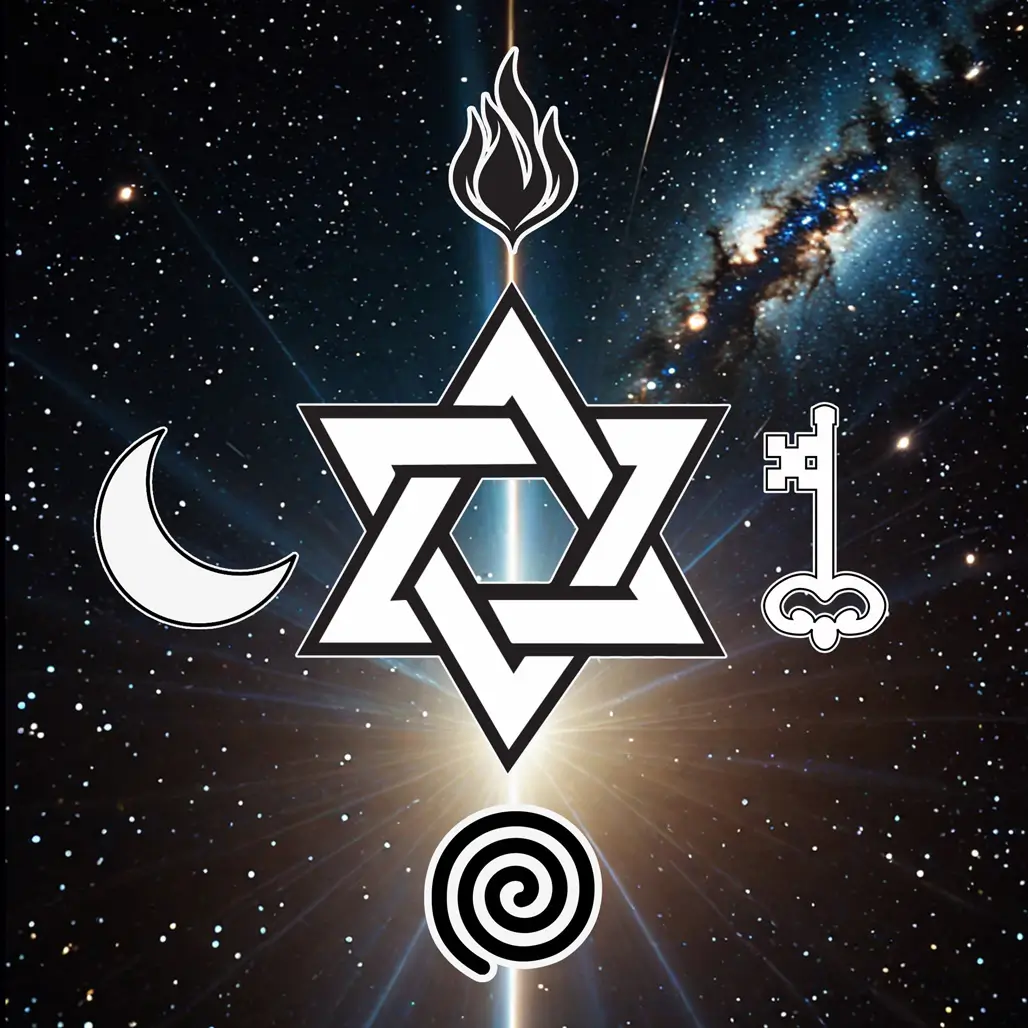
The Moonless Gate
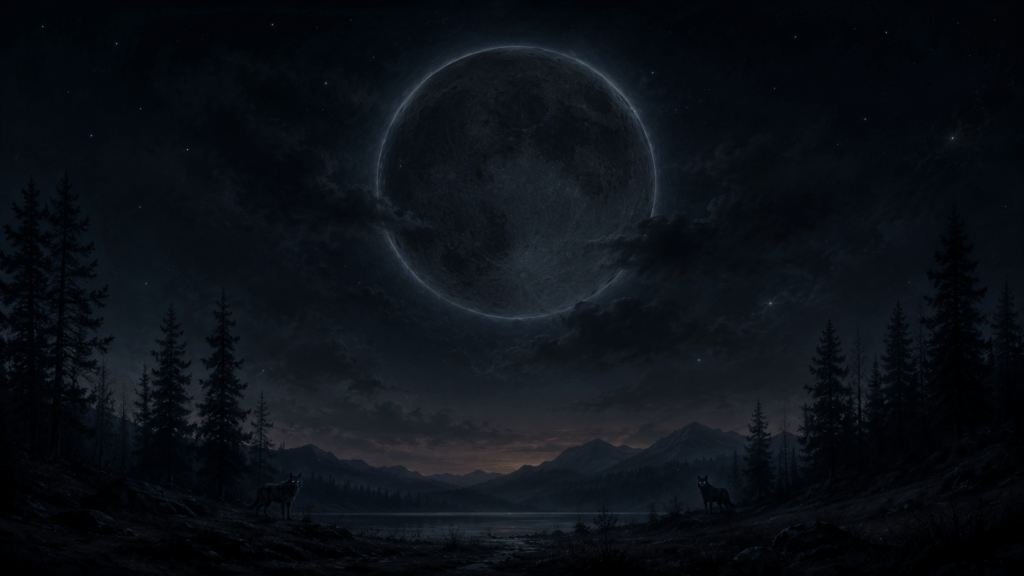
On a moonless night, darkness has a different weight. Without even the faint silver witness of the Moon, the sky can feel strangely emptied, as though something ancient has withdrawn behind a veil. For those who do not know the Moon’s rhythm, such a night may feel unsettling. The world seems less reflected, less watched, less blessed by light.
Yet the Moon has not abandoned the night.
She has entered the hidden part of her own cycle, the place where her face turns away from us and her light withdraws from sight. To the human eye beneath the black sky, she is simply gone. No silver path on water. No pale blessing on the road. No white curve above the trees. No visible witness keeping watch over the fields, the windows, the altar, or the restless sleeper.
This is the Dark Moon.
It is the moonless gate between what has ended and what has not yet begun. It is not the bright revelation of the Full Moon, when everything shines too clearly to be denied. It is not the first tender crescent of the New Moon, that slim blade of return after the dark has done its secret work. The Dark Moon is the hidden hinge in the lunar cycle. The pause. The held breath. The unlit room before the door opens.
For those who learned to listen beneath its darkness, it became something more than absence: a sacred interval, a night of clearing, dream, shadow, and unseen preparation.
In astronomical terms, the Moon has moved between Earth and Sun. The side facing us is not lit. The Moon rises and sets near the Sun, hidden in daylight, swallowed by glare, absent from the night. Modern astronomy calls this phase the New Moon. Magical language often makes a finer distinction. The Dark Moon names the moonless threshold itself, while the New Moon names the return of visible light, that first slender crescent that proves something has survived the dark.
This difference matters.
The Dark Moon is not the beginning. Not yet. It is the place before beginning. It is the last breath after release and before renewal. It is the silence between the exhale and the inhale. The seed has not broken the soil. The infant has not cried out. The vision has not taken form. The old pattern has loosened, but the new one has not yet found its face.
Anyone who has lived through deep change knows this place.
A relationship ends, but the next life has not begun. A belief dies, but no truer one has arrived. A role, identity, vocation, or self-image falls away, and we stand strangely naked inside ourselves, unable to go back, unable to move forward with any grace. The world may demand plans, explanations, updates, and cheerful declarations of growth. But inside, something quieter is happening. Something older. The soul has entered the moonless chamber.
The Dark Moon teaches that not all becoming is visible.
Some transformations begin in darkness because they cannot begin anywhere else. The caterpillar does not become a butterfly in public. The seed does not germinate in the open air. The wound does not always heal while being watched. The psyche, too, has its hidden seasons. There are times when the deeper self draws the curtains, lowers the lamps, and asks us to stop performing our own renewal before it has truly begun.
This is not failure. It is gestation.
The Dark Moon has long been tied to endings, purification, banishing, ancestral attention, dream work, and the emptying of what has become stale or false. In Hekatean practice, the Dark Moon is often linked with Deipnon, the old monthly offering made to the goddess of the liminal realm, Hekate, at the end of the lunar month. Food might be left at a crossroads or threshold. The home might be cleaned. Debts of the spirit might be faced. Something no longer fit to carry might be surrendered.
But the deeper meaning is not merely ritual housekeeping.
Deipnon points toward a sacred secret of the inner life: what has not been cleared will cross the threshold with us. The stale grief, the hidden resentment, the old vow made in pain, the unexamined fear, the need to be seen in a particular way, the hunger for control, the private shame wrapped in clever language. These things do not disappear because the calendar turns. They wait at the gate.
The Dark Moon asks for honesty before intention.
This is why it differs from the bright, popular language often placed around the New Moon. Set intentions. Call in abundance. Begin again. Make your list. Write your vision. There is nothing wrong with these acts when the timing is true. But before the first crescent appears, the Dark Moon stands in the doorway and asks a harder question:
What are you still carrying that cannot come with you?
The answer may not come as a sentence. It may come as a tight throat, a clenched jaw, a flutter beneath the ribs, a hand resting over the belly without knowing why. The hidden mind speaks in sensation before it speaks in words. A dream. A sudden memory. A flash of anger too old for the present moment. A wave of fatigue when we approach the truth. A strange tenderness in the chest when a name is spoken.
The Moon has always belonged to these tides. In astrology, the Moon is not merely mood. She is memory, instinct, emotional hunger, the mother-field, the body’s learned sense of safety, the way we return to ourselves when no one is watching. She shows the private weather. She governs the inner waters, those quiet currents beneath the polished surface of the conscious self.
The Dark Moon, then, is the lunar descent into the hidden mind—the underworld within.
Not the unconscious as a concept. The unconscious as the felt weather of the psyche. The room in shadow where the old shapes live. The place where childhood made agreements that adulthood still obeys. The place where grief learned to hold its breath. The place where desire hid itself to stay safe. The place where intuition waits, not as fantasy, but as a quiet animal with night-seeing eyes.
To enter the shadow of the Dark Moon is to stop demanding immediate light.
This is difficult for the modern mind. We are trained to seek answers quickly, to turn every silence into content, every wound into a lesson, every dark night into a branded rebirth. But the Dark Moon resists this. It does not explain itself too soon. It does not brighten because we are uncomfortable. It does not rush to console the ego. It holds us in the blackness long enough for our false lights to burn out.
That is the Dark Moon’s blessing.
A false light is anything we use to avoid the truth: spiritual slogans, premature forgiveness, forced positivity, constant interpretation, magical thinking that refuses emotional honesty, or the need to make every ache meaningful before we have fully felt it. The Dark Moon does not strip these away as punishment. It simply turns off the outer lamps, and what cannot shine from within goes dim.
Then we can see differently.
There is a kind of sight that only awakens in the dark. It does not look outward. It listens. It feels for the shape of what is near. It notices the breath, the floor, the pulse, the old reflex to flee. It senses where the body braces against truth. It hears what the waking mind has talked over for years.
This is why the Dark Moon belongs to thresholds and crossroads. A threshold is not only a doorway between one room and another. It is the charged strip of space where one condition ends and another has not fully begun. A crossroads is not only a place where roads meet. It is the moment when choice becomes real, and the old path can no longer pretend to be the only path.
At such places, Hekate appears.
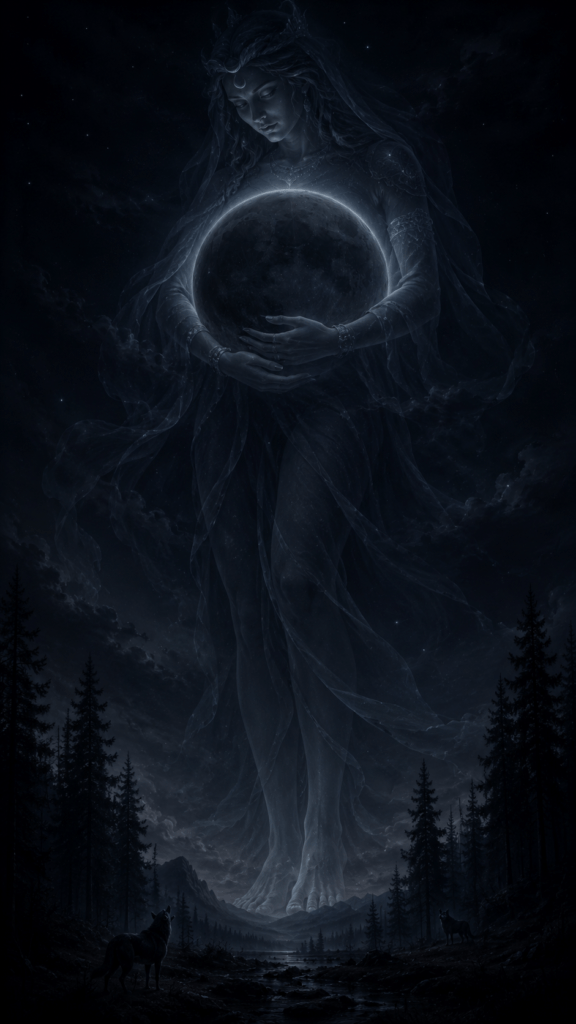
Goddess of crossroads, torch-bearer, key-holder, guardian of liminal spaces, she is at home where the map ends. Her presence does not erase the darkness. That is not her work. She does not flood the unseen with daylight and spoil the mystery. She carries a torch.
A torch does not abolish night. It gives enough light for the next step.
image: The Goddess Hekate embracing the Dark Moon
Hekate says: *
“I am of the Threshold, the Crossroads, the space between all things.”
That line belongs to the Dark Moon as much as to the goddess. The moonless night is the space between all things. Between endings and beginnings. Between death and birth. Between knowing and not knowing. Between what has dissolved and what has not yet formed. It is not empty in the shallow sense. It is empty the way a womb is empty before conception, empty the way a field is empty beneath winter frost, empty the way silence is empty before the song begins.
“In the deepest stillness of the void where creation stirs, I walk.”
This is the heart of the Dark Moon mystery. Creation does not always stir in light. Sometimes it stirs in the void. Sometimes the first sign of new life is not excitement, but withdrawal. Not clarity, but a strange inward pull. Not confidence, but a quiet refusal to keep lying. The Dark Moon is not barren. It is concealed. It does not display its fertility on the surface.
The night of the Dark Moon can be frightening.
The psyche often fears the unknown more than it fears pain. Pain, at least, is familiar. We know the shape of our old wounds. We know how to arrange our lives around them. We know the habits that keep them fed. But the unknown asks more from us. It asks us to loosen identity. It asks us to stand without the old costume. It asks us to stop making a shrine of the injury and start listening for the life trapped beneath it.
This is where shadow rises.
The Dark Moon does not create the shadow. It reveals our relationship to it. When the outer moon disappears, we may feel the inner shadows move closer. The thoughts we avoid. The envy we dress in moral language. The anger we call discernment. The grief we hide under usefulness. The desire we judge before we understand it. The fear that if we truly change, someone we love will not know how to love us anymore.
These are not flaws to be burned in haste.
They are doorways.
To treat the shadow as trash is to miss its message. To romanticize it is just as dangerous. The shadow is not glamorous. It is often cramped, defensive, repetitive, and young. It may speak through shallow breath, a sour stomach, guarded pelvis, restless hands, sudden heat in the face, or a cold drop through the chest. It does not need theater. It needs presence.
The Dark Moon provides the kind of darkness where presence can ripen.
Not every truth should be dragged into daylight the moment we find it. Some truths need to be sat with. Some need tears. Some need a candle, a bowl of water, a night of sleep, a page in the journal, a long walk under a sky with no moon. Some need to be held without being solved. Some need the dignity of silence.
This is one reason the Dark Moon is sacred to magical practice. Magic, at its depth, is not the attempt to dominate reality with desire. It is the art of entering right relationship with seen and unseen forces. It asks for timing. It asks for listening. It asks for sacrifice in the older sense: to make sacred. At the Dark Moon, the sacrifice is often simple and hard. We give up the lie. We give up the posture. We give up the version of the story that protects us from the more painful truth.
Only then can intention become more than wish.
An intention made before release may carry the old pattern inside it. We may ask for love while still clinging to abandonment as identity. We may ask for abundance while still bound to the drama of scarcity. We may ask for power while still afraid to be accountable. We may ask for peace while refusing the grief that peace requires.
The Dark Moon clears the altar.
It does not promise comfort. It offers connection.
Connection with the deep self. Connection with the body’s quieter knowing. Connection with the ancestors of our own psyche, those earlier selves who made choices under pressure and still live in us as reflex, armor, longing, or fear. Connection with the unseen intelligence that moves beneath linear thought.
Then, when the first crescent appears, the New Moon is not merely a pretty symbol of hope. It is earned light. It is the first visible sign that the hidden passage through the Dark Moon’s shadow has done something to us. It does not mean everything is healed. It does not mean the future is certain. It means the night has opened a narrow gate, and through that gate a sliver of light has returned.
The New Moon crescent is small because beginnings are small.
This, too, teaches a sacred secret. We often want rebirth to arrive as a grand revelation, a total reordering, a shining proof that the darkness was worth it. But most true beginnings come quietly. A calmer breath. A clearer no. A softer grief. A different choice in a familiar moment. The ability to stay in the room. The first honest sentence. The hand unclenching. The body trusting the ground again.
The Dark Moon prepares us for this kind of beginning.
It teaches us that darkness is not the opposite of life. Darkness is one of life’s hidden chambers. The embryo forms in darkness. Roots deepen in darkness. Dreams gather in darkness. The dead are mourned in darkness. Lovers close their eyes. Mystics enter caves. The old self loosens its grip when the conscious mind finally grows tired of its own noise.
Still, the Dark Moon is not a place to linger forever.
A threshold is meant to be crossed. The danger of the dark is not only fear. It is attachment. We can become loyal to the underworld passage and resist the return. We can mistake depth for heaviness, mystery for obscurity, solitude for exile. The Dark Moon asks us to descend, but it does not ask us to disappear. It asks us to listen, release, and receive the first hint of what comes next.
“I walk between the worlds, and you walk with me. Where endings come, I kindle the torch. Where paths diverge, I set the key. Come, rise, and be made new beneath the Dark Moon’s stillness.”
This is not an escape from darkness. It is companionship within it. The goddess does not remove the threshold. She stands with the seeker at the crossing. She does not make the choice for us. She sets the key where the hand can find it.
The Dark Moon, then, is not only a phase of the Moon. It is an initiatory pattern embedded in nature. It repeats each month in the sky, but it also repeats in the psyche, the body, the heart, the life path. Again and again, something wanes. Something empties. Something goes dark. Again and again, we are asked not to panic at the loss of light. Again and again, we learn that the unseen is not the same as the unreal.
To honor the Dark Moon is to honor the sacred pause before emergence. It is to stop treating the invisible as empty. It is to bow to the hidden work of the soul. It is to allow the old month, the old pattern, the old wound, the old self, to complete its descent without rushing to decorate the next beginning.
On the Dark Moon, the night sky gives us no face to adore.
That is part of the rite.
Without the Moon’s visible beauty, we meet the mystery without ornament. We are left with breath, shadow, silence, memory, and the black mirror of the unseen. We are left with the question beneath all questions:
Who am I when no light reflects me back to myself?
The answer cannot be forced. It may not arrive tonight. But the asking is already a crossing.
And somewhere beyond sight, the Moon continues her turning.
Hidden does not mean absent.
Dark does not mean dead.
The first crescent is already being prepared.
A Simple Dark Moon Practice
On the night of the Dark Moon, sit in a dim room with one unlit candle before you. Keep a bowl of water nearby. Let the room be quiet.
Place one hand on your heart and one hand on your lower belly. Take three slow breaths. Do not try to become peaceful. Simply notice what is true.
Ask inwardly:
What is complete?
What am I carrying that cannot cross the next threshold with me?
What waits beneath the silence?
Write one sentence naming what you are ready to release. Keep it plain. Fold the paper and place it beside the bowl of water.
Then sit for a few minutes without asking for anything else. Let the body speak first. Let the breath move. Let the dark be dark.
When you are ready, whisper:
Taken, transformed, released.
Pour the water into the earth, or into a plant, and leave the candle unlit until the first sliver of crescent Moon appears. When that first crescent returns, light the candle and name one small true beginning.
If you would like a more in-depth Dark Moon ritual that you can do by yourself or with a group, Click Here to download Hekate’s Deipnon Ritual
“I am Hekate of the moonless gate, and I tell you: the Dark Moon is not where the soul is abandoned, but where it is asked to become honest enough to be renewed. Deipnon is the sacred clearing, the last offering before the next road opens, the moment when what is stale, hidden, and finished is laid down at the threshold. Do not fear the night that gives you no face to adore; in that darkness, the false lights fade, and the deeper sight awakens. I do not come to erase the shadow, but to stand within it beside you, torch in hand, until the first true crescent of your becoming is ready to return.”
*Hekate quotations are channeled material I received.
Leave a Reply