Entering the Labyrinth of the Shadow
Revised and updated July 2026
In the ancient myth of Theseus and the Minotaur, Theseus accepts the challenge of entering a dark labyrinth and facing the horrible beast hidden within it. Metaphorically, he undergoes what we might now recognize as shadow work.
The myth offers a symbolic map of that process: not the destruction of our inner monsters, but the conscious transformation of our relationship with the wounded and destructive forces hidden within the psyche.
The Myth of Theseus and the Minotaur
King Minos of Crete defeated the Athenians in war and demanded that, at nine-year intervals, seven Athenian boys and seven Athenian girls be sent to Crete to be devoured by the Minotaur.
The Minotaur was a creature that was half human and half bull. His birth followed King Minos’s failure to honor a vow he had made to Poseidon. Rather than face the consequences openly, Minos concealed the creature from the world.
Minos ordered Daedalus, a gifted inventor, architect, and craftsman, to design the labyrinth. Its winding passages were so difficult to follow that anyone who entered would become lost. The Minotaur was imprisoned at its center, hidden from sight but kept alive through the repeated sacrifice of Athenian youths.
Theseus, the son of the Athenian king Aegeus, volunteered to slay the monster and end the sacrifices. He took the place of one of the young Athenians being sent to Crete.
When Theseus arrived, King Minos’s daughter Ariadne chose to help him. On the advice of Daedalus, she gave Theseus a ball of thread so that he could find his way out of the labyrinth. Theseus tied one end to the entrance and unwound it as he moved through the dark passages.
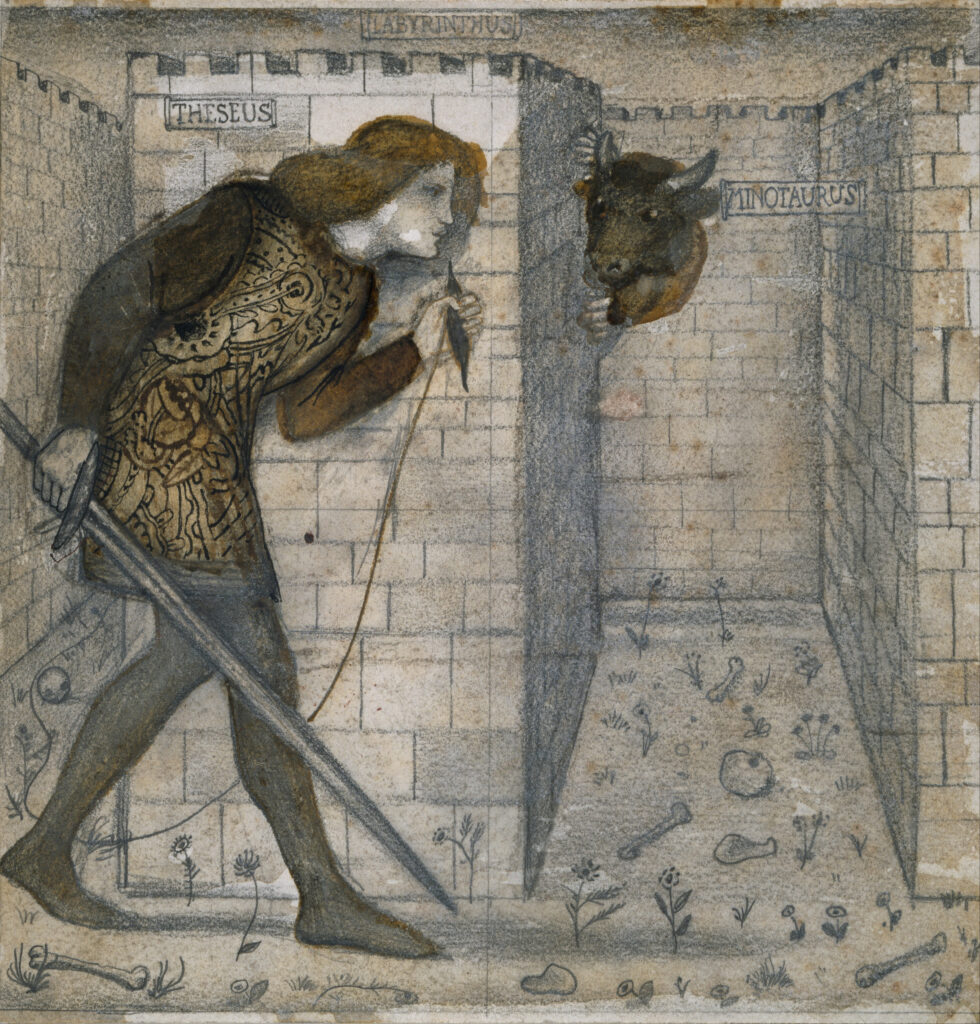
Armed with a sword, Theseus reached the center of the labyrinth, fought the Minotaur, and killed him. He then followed Ariadne’s thread back to the entrance and escaped with her and the surviving Athenian youths. This basic sequence appears in the ancient accounts attributed to Pseudo-Apollodorus and later retellings of the myth.
Seen through a psychological and spiritual lens, the story offers a way to understand the inner journey through fear, pain, unconscious patterns, and the possibility of transformation.
What the Labyrinth, Minotaur, Ariadne, and Sword Represent
The labyrinth represents the unconscious shadow within the psyche: the hidden matrix of memories, instincts, fears, wounds, needs, desires, and emotional patterns that influence our thoughts and behavior without our full awareness.
The Minotaur is the inner monster that lives within those avoided and unseen places. He represents disowned, wounded, ashamed, instinctive, or destructive aspects of oneself that have been shut away from conscious life.
Yet the Minotaur is not born evil in any simple sense. His existence begins with a broken vow and an attempt to conceal its consequences. He is then locked away, isolated, and fed through repeated sacrifice.
This offers an important parallel with the shadow psyche. Many inner monsters were formed through pain, neglect, humiliation, secrecy, fear, rejected needs, family patterns, or experiences we did not know how to understand. What cannot be faced openly is often pushed deeper into the labyrinth.
Hiding the monster does not make it disappear.
A shadow aspect may show itself through rage, withdrawal, possessiveness, compulsion, self-sabotage, numbness, addiction, projection, or the urge to control other people. It may also hold qualities that were rejected but are not inherently harmful, such as strength, sexuality, ambition, creativity, assertiveness, or the ability to say no.
Jungian psychology describes the shadow as those aspects of the personality that the conscious Ego does not recognize or accept. Some are destructive. Others contain valuable qualities that were rejected because they did not fit family, cultural, moral, or social expectations.
In my own inner work, I have found that the monsters we fear are rarely what they first appear to be. Beneath anger may be grief. Beneath control may be terror. Beneath withdrawal may be an old belief that closeness is dangerous. The Minotaur often carries a history. When we approach it with courage and discernment, we begin to see not only what it has done, but why it came into being.
Theseus represents the individual who becomes willing to enter the labyrinth. He is the conscious self, the “I” perspective, and the part of the personality capable of making choices, setting intentions, and accepting responsibility.
He begins as the Seeker and becomes the Hero by completing his quest.
The Seeker is also an initiate: one who follows a path of learning and seeks the arcana, the hidden or esoteric knowledge needed to accomplish a difficult task. Psychologically, that hidden knowledge is knowledge of oneself.
Ariadne represents guidance. Theseus may possess courage and strength, but he cannot enter the labyrinth and return safely through heroic will alone. He needs a living connection to something beyond himself.
Ariadne’s thread may represent intuition, spiritual practice, honest self-observation, a trusted relationship, therapy, counseling, or a steady inner sense that remembers the way back when the conscious mind becomes confused.
The sword represents the spiritual and psychological tools carried by the Seeker: insight, discernment, truthfulness, clear boundaries, determination, self-discipline, and the power to interrupt a destructive pattern before it causes further harm.
The Mythic Quest
A mythic quest places the Hero against overwhelming odds. The Hero leaves the familiar world, crosses a threshold, endures an ordeal, and returns changed. His actions bring benefit not only to himself, but also to others under his care and protection.
Joseph Campbell described this recurring pattern as the Hero’s Journey. Its broad movement includes separation from the familiar, initiation through ordeal, and return. Campbell’s model offers a way to interpret myths and stories. It should not be mistaken for a clinical theory of psychology or a method of mental-health treatment.
Theseus leaves the world of sunlight and descends into an enclosed underground maze. He searches for the creature that others fear and feed but refuse to face. His task is not only to survive the encounter. He must return and bring the others with him.
The Seeker must also dare to enter the hidden passages of the psyche. This is not a search-and-destroy mission. It is a process of discovering and learning to guide forces that have acted without conscious restraint.
What Does It Mean to Defeat the Minotaur?
In the myth, Theseus kills the Minotaur. In psychological shadow work, defeating the Minotaur does not mean killing, rejecting, or cutting away a wounded part of oneself.
We do not become whole by declaring war on our pain.
The Minotaur’s death symbolizes a change in power and relationship. The monster no longer rules the labyrinth unseen or demands continued sacrifice from the darkness.
What was unknown becomes known. What was uncontrolled becomes recognized and given limits. What once acted through compulsion may now be met with awareness, choice, responsibility, and restraint.
The wounded part is not erased. Its unconscious authority is ended.
The old pattern may remain as a memory, reflex, feeling, or temptation, but it no longer makes every decision. Understanding the Minotaur’s history does not excuse its harmful behavior or permit it to continue attacking. Compassion and accountability must remain together.
The word “defeat” remains useful because it takes great effort to find and face the monsters of the shadow psyche. We must overcome the fear that keeps us from entering the labyrinth, along with the reflex to deny, excuse, project, flee, or give up when painful material begins to rise.
The monster may first appear in the body before we know its name.
It may come as tightness in the throat, terror pressing against the chest, a hollow emptiness in the gut, a clenched jaw, shallow breathing, restless hands, sudden fatigue, or the old urge to leave the room without moving. The body senses the entrance to the labyrinth before the mind understands where it has arrived.
The task is not to force the body into silence. It is to remain near enough to what is happening that we can listen without becoming consumed by it.
Insight reveals what has been hidden. Discernment separates present reality from old fear. Boundaries prevent the wounded part from harming oneself or others. Self-discipline helps the Seeker remain present when avoidance feels easier.
The sword may also represent the clean, decisive act that interrupts a destructive pattern: refusing the drink, leaving the argument, telling the truth, asking for help, naming manipulation, or stopping oneself before an old wound becomes another person’s injury.
The Ego and the Inner Community
It is the Minotaur’s unconscious rule, not the Ego itself, that must be defeated.
The Ego provides the conscious sense of “I” that helps us make choices, set limits, and take responsibility for our actions. Trouble begins when it mistakes itself for the whole psyche and claims sole authority over what is true, valuable, or necessary. It then becomes inflated, rigid, and cut off from the deeper life within.
A balanced Ego serves a greater purpose. It listens to the Soul or Higher Self, remains in relationship with the Inner Community of the psyche, and considers how its choices affect other people and the greater good.
In that role, the Ego becomes grounded, capable, and useful. It does not rule the psyche by force. It helps its many parts remain in conscious relationship.
Jungian thought makes a similar distinction between the Ego and the larger Self. The Ego is the center of ordinary conscious identity, while the Self represents the greater whole of the psyche. The Ego is part of that whole rather than its sole authority.
Spiritual practice, reflection, and self-observation can help us recognize when the Ego is acting from fear, inflation, shame, wounded pride, or unconscious need.
Becoming a Seeker
Not everyone identifies as a seeker, and not everyone feels ready to enter the labyrinth of self-examination. The desire to understand one’s inner life cannot be forced through pressure, persuasion, religious authority, or spiritual pride.
Readiness comes in its own time, often after an experience breaks through familiar patterns and makes the old way of living harder to sustain.
Being a seeker does not make a person wiser or more worthy than others. It means that, at this point in life, they feel called to become more conscious of the impulses, wounds, fears, and hidden motives that influence their choices.
Some people repeat patterns without yet feeling a need to question them. They may find themselves in similar relationships, conflicts, disappointments, or emotional states again and again. Yet no one can be compelled to awaken according to another person’s timetable.
Pressure produces compliance rather than genuine inner change.
The process of facing the Minotaur is therefore personal. It must never become an excuse to diagnose, shame, convert, pressure, or manipulate another person. When spiritual principles harden into religious demands that everyone must obey, they lose much of their power to guide an honest inner life.
The seeker is not superior. The seeker has simply become willing to look.
The Reward of Shadow Work
Those who enter the labyrinth and develop a more conscious relationship with the shadow psyche become less driven by unconscious compulsions, fixations, projections, and delusions.
This does not mean they will never feel fear, anger, envy, shame, grief, or the desire to run away. It means they have a better chance of recognizing what is happening before the feeling becomes an action or the wound becomes a repeated pattern.
The reward is not perfection. It is greater freedom of response.
There is no spiritual magic pill. No single insight, ritual, workshop, book, revelation, psychedelic experience, or moment of awakening completes the work. A powerful experience may open the door to the labyrinth, but we still have to walk its passages.
There are no spiritual mountains that, once climbed, mark the end of the journey. Being spiritually awake is more like surfing the many waves of life’s circumstances and challenges. We never finish unless we fall off the surfboard. Then we either flounder in the water or climb back on and prepare for the next wave.
Each descent may reveal another part of the Inner Community: the frightened child, the angry protector, the abandoned lover, the controlling parent, the shamed body, the grieving heart, or the instinctive creature that learned to survive before the conscious mind understood what survival meant.
Spiritual accomplishment lies in bringing these shadow aspects into the light, attending to what they carry, and receiving their lessons without allowing their destructive tendencies to rule.
Some monsters guard gifts.
Anger may guard a violated boundary. Control may guard terror. Numbness may guard unbearable grief. Jealousy may reveal a part that fears it will never be chosen. Aggression may contain the strength needed to protect oneself, speak clearly, or leave a harmful situation.
Shadow Work and Trauma
Personal reflection, journaling, meditation, spiritual practice, and honest conversation can help many people recognize their patterns. Deeper trauma, however, may require more support than solitary inner work can provide.
Trauma is not proof of spiritual weakness. Becoming overwhelmed, frozen, dissociated, panicked, or physically ill while approaching painful material does not mean that the Seeker lacks courage.
Sometimes the most courageous act is to stop, return to the entrance, and seek a guide.
Deep trauma work is not a contest of willpower. It should not be rushed, forced, or used to prove spiritual strength. A person may need help learning how to remain present in the body, regain a sense of safety, and approach inner material in smaller steps.
Psychotherapy includes forms of treatment intended to help people identify and change troubling emotions, thoughts, and behaviors. Trauma-informed practice places strong attention on safety, trust, collaboration, and personal choice.
Working with an experienced counselor, licensed therapist, psychologist, or qualified coach can help a person understand the labyrinth’s twists and turns. Different forms of help serve different needs. Serious trauma, mental illness, crisis, or danger to oneself or others calls for licensed mental-health or emergency support.
Spiritual counseling or coaching may also offer guidance when the person’s needs fall within those forms of practice. I am one possible source of that guidance, though the deeper point is to find someone ethical, trustworthy, appropriately trained, and able to respect your boundaries and personal path.
Ariadne’s Thread and the Way Back
I have come to understand the labyrinth not as a place we enter only once, but as an inner country we revisit throughout life. Each descent asks something different of us. Sometimes we carry a sword of clear discernment. Sometimes all we have is Ariadne’s thread: a spiritual practice, a trusted guide, an intuitive feeling, or the steady knowledge that a way back still exists.
Ariadne’s thread is the quiet line of continuity that reminds us who we are while we face what has been hidden. Courage may take us into the labyrinth, but courage alone does not always bring us safely back. We also need guidance, relationship, and a path of return.
For those struggling with inner monsters that keep returning to sabotage or disrupt their lives, I hope this myth helps you believe in yourself again.
There is power in reaching the point where things begin to make sense. When we recognize what is happening in the body and psyche, we gain a better chance of staying present, grounding ourselves, tending our fear, and choosing a different response.
The labyrinth does not vanish.
The Minotaur no longer rules it.
And because Ariadne’s thread remains in our hands, we know there is a way back into the light.
References
Campbell, Joseph. The Hero with a Thousand Faces. Princeton University Press, 1949.
International Association for Analytical Psychology. “The Shadow,” “The Self,” and “Individuation.”
Jung, C. G. Aion: Researches into the Phenomenology of the Self. Collected Works of C. G. Jung, Volume 9, Part II. Princeton University Press.
Jung, C. G. Two Essays on Analytical Psychology. Collected Works of C. G. Jung, Volume 7. Princeton University Press.
National Institute of Mental Health. “Psychotherapies.”
Pseudo-Apollodorus. The Library, Epitome 1.7–1.9. Translated by Sir James George Frazer. Loeb Classical Library, 1921.
Further Reading
Johnson, Robert A. Owning Your Own Shadow: Understanding the Dark Side of the Psyche. HarperSanFrancisco, 1991.
See Also
Understanding Archetypes explores the figures and voices that form the Inner Community of the psyche, and how neglected archetypal energies seek recognition through emotion, behavior, and disruption.
The Void: Constant Feature of Consciousness considers the unknown depths beneath ordinary awareness and the inner space from which fear, revelation, and new forms of becoming may arise.
Leave a Reply