A Path to Inner Work and Self-Discovery
Revised and updated July, 2026
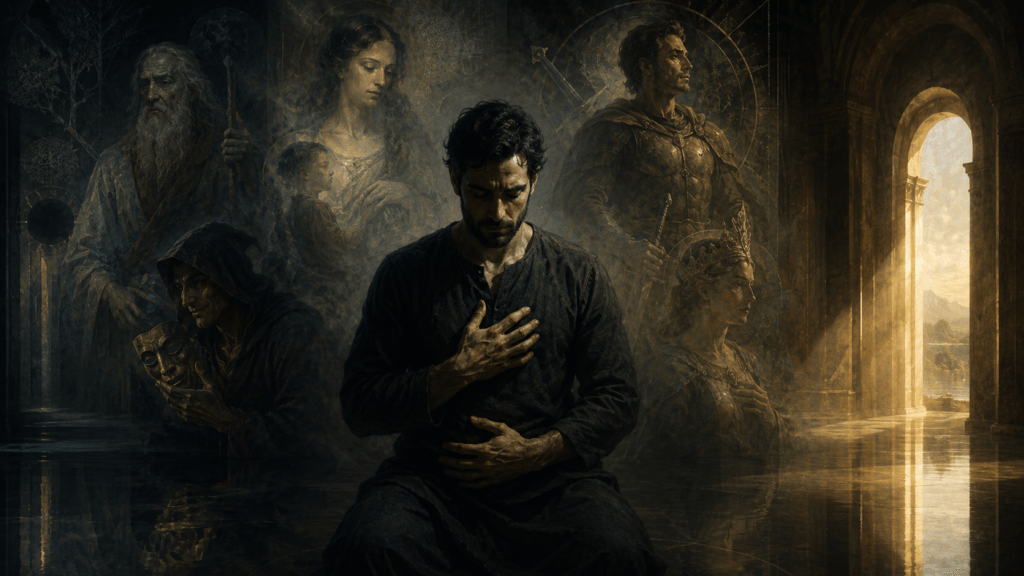
You may experience an archetype before you know its name.
It may arrive as a dream figure standing at the edge of sleep, a sudden pull toward courage, a repeated pattern in love, a fear that tightens the belly, or an old image that keeps returning until you finally stop and ask what it wants. Archetypes rarely appear as clean definitions. They move through symbol, mood, longing, story, fantasy, memory, dream, and the body.
In Jungian psychology, archetypes are deep patterns of the collective unconscious. They are not merely ideas. They are recurring forms of psychic life that appear in myths, dreams, art, religion, relationships, and personal growth. The Hero, the Mother, the Trickster, the Sage, the Lover, the King, the Goddess, and the Shadow are not only characters in stories. They are also patterns of human experience.
When an archetype becomes active in us, it may shape how we see ourselves, what we desire, what we fear, what we repeat, and what kind of person we feel called to become. We may think we are making a purely personal choice, yet beneath that choice there may be an older pattern moving through us.
This does not mean we are powerless. It means we are deeper than we think.
The work begins when we learn to notice the archetypal pattern, give it language, listen to its message, and respond with consciousness rather than compulsion.
What Are Archetypes?
Archetypes are personified patterns of the collective unconscious. They carry recognizable traits, themes, images, motives, and emotional tones. They influence personal thinking, desire, fear, behavior, belief, fantasy, and dream life.
Noted Swiss psychologist Carl Jung used the term archetype to describe universal psychic patterns that arise from the collective unconscious. These patterns do not appear in pure form. We encounter them through images, symbols, myths, dreams, moods, impulses, stories, and behavior. Jung wrote that archetypes are not inherited ideas, but inherited possibilities of form. They shape psychic material in the way instinct shapes behavior.
The word archetype comes from the Greek roots archein, meaning original or old, and typos, meaning pattern, model, or type. An archetype is an original pattern from which similar figures, roles, images, and experiences seem to arise.
This is why certain figures keep appearing across time and culture. The Wise Old Man. The Great Mother. The Hero. The Trickster. The Lover. The Destroyer. The Child. The King. The Priestess. The Shadow. These figures change their clothing, names, rituals, myths, and cultural setting, but the pattern beneath them remains recognizable.
Robert A. Johnson describes archetypes as recurring types with traits that appear together in familiar patterns. The “virtuous maiden,” the “wise queen,” the “courageous warrior,” and the “puritan” are not random figures. They are examples of psychic patterns that return again and again in story, religion, family life, fantasy, and personal identity.
Archetypes are transpersonal in origin but personal in experience. They belong to the collective unconscious, yet they act through the personal unconscious of the individual. Each person meets the archetype through their own history, wounds, beliefs, body, culture, and stage of life.
This is why the Mother archetype may feel warm and nourishing to one person, suffocating to another, absent to another, and terrifying to someone else. The archetype may be collective, but the encounter is intimate.
The Archetypal Face
I use personified language for archetypes because this is often how they appear in dreams, imagination, myth, and inner work. An archetype may not be a person in the ordinary sense, yet it may behave like an inner figure with a recognizable face, mood, role, purpose, and field of concern.
Each archetype has what I call an archetypal face. This is the way the archetype presents itself to consciousness. It may appear as a dream character, a mythic figure, a repeated fantasy, a sudden emotional charge, a voice inside the psyche, or a symbolic image that carries unusual force.
The Fool has one face. The Sage has another. The Hero carries a different posture from the Mother. The King does not move through the psyche in the same way as the Lover, the Warrior, the Priest, or the Trickster.
These archetypal faces are not rigid. They shift according to culture, time, gender, personal history, and the condition of the psyche receiving them. Yet each archetype still has a center of gravity. It draws attention toward certain questions and away from others.
The Hero gathers around courage, ordeal, risk, sacrifice, and the crossing of danger.
The Mother gathers around nurture, body, birth, protection, nourishment, belonging, and loss.
The Sage gathers around knowledge, discernment, reflection, silence, and the long view.
The Trickster gathers around disruption, inversion, mischief, surprise, and the humbling of fixed certainty.
The King gathers around order, blessing, sovereignty, responsibility, and the well-being of the realm.
The Shadow gathers around what has been denied, feared, disowned, rejected, or pushed out of sight.
These are not boxes. Human beings are not so neat. Archetypes overlap, blend, borrow, conflict, and constellate together. A mother protecting her child may act through the Mother, the Warrior, and the Hero all at once. A spiritual teacher may carry the Sage, the Priest, the Trickster, and the Shadow in the same body.
Still, the distinctions matter. They help us see which pattern has become active and what kind of psychic energy is moving through us.
Domain of Influence
Each archetype also has a domain of influence.
A domain of influence is the area of life the archetype seems to care about, organize, guard, or disturb. It is the field where the archetype applies pressure. It is where its questions arise.
The Magician and the Priest are concerned with hidden knowledge, symbolic action, transformation, ritual, and the unseen forces that shape life. The King is concerned with order, blessing, stewardship, judgment, and the condition of the realm. The Lover is concerned with beauty, union, desire, intimacy, devotion, and the ache of separation. The Warrior is concerned with discipline, action, protection, conflict, and the courage to stand.
The domain of influence helps us understand why an archetype appears when it does.
The Hero may become active when life demands risk.
The Sage may appear when a person must stop reacting and learn to see.
The Shadow may rise when a person keeps betraying a truth the body already knows.
The Trickster may enter when life has become too rigid, too proud, too certain, or too false.
The King may stir when a person must take responsibility for the condition of their life, home, family, work, or creative field.
This is one reason archetypes matter for personal growth. They do not merely decorate the psyche with interesting symbols. They point toward areas of life where energy, conflict, growth, and responsibility have gathered.
What Do Archetypes Want?
When I say an archetype “wants” something, I don’t mean this in a common, literal sense. I mean that, in inner experience, an activated archetype may behave as if it seeks recognition, expression, relationship, and conscious response.
Archetypes want relatedness.
They want their message to reach consciousness. They want their energy to find form in a person’s life. They want to be seen, heard, understood, and answered. When we remain unconscious of them, we may act them out without realizing what has taken hold of us.
This is how a person can become possessed by an archetypal pattern.
Someone caught by the Hero may need every difficulty to become a battle.
Someone caught by the Mother may confuse care with control.
Someone caught by the Sage may hide from life behind analysis.
Someone caught by the Lover may mistake longing for love.
Someone caught by the King may confuse order with domination.
Someone caught by the Shadow may project their own denied material onto everyone around them.
The archetype itself is not the problem. The problem is unconscious identification. We stop having an archetypal experience and begin being lived by it.
A conscious relationship changes this. When we notice the archetype, name its pattern, feel its effect, and ask what it is trying to show us, we regain some freedom. We do not have to obey every impulse. We do not have to reject it either. We can listen, weigh, respond, and choose.
That is where inner work begins.
How Archetypes Function
Archetypes exist in the collective unconscious, but they reach us through the personal unconscious. They enter personal life through images, moods, dreams, fantasies, memories, compulsions, symbols, bodily sensations, attractions, aversions, and repeating situations.
The archetype may first appear as a quiet background pressure.
A mood changes.
A dream lingers.
A certain image keeps catching the eye.
A phrase repeats in the mind.
A person feels drawn toward a book, myth, deity, animal, place, or story without knowing why.
A tightness appears in the throat when a certain subject arises.
The belly hardens when a truth gets close.
The hands grow restless.
The breath becomes shallow.
The body knows something before the mind has words for it.
At first, these signs may seem small. They may look like coincidence, passing emotion, or ordinary distraction. Yet when archetypal material presses toward consciousness, it often returns.
It repeats.
If ignored, it grows louder.
This is one of the most important things to understand about archetypal influence: what we refuse to hear quietly may eventually arrive as disruption.
When the Message Is Ignored
An archetype may begin by trying to get our attention through subtle signs. A dream. A symbol. A recurring image. A strange pull toward a subject. A line in a book that seems to burn through the page. A mood that arrives without an obvious cause. A sudden memory. A pattern we keep seeing in other people but refuse to recognize in ourselves.
If these signals go unnoticed, the archetype may press harder.
The dreams become more vivid.
The synchronicities become more pointed.
The same conflict appears in several relationships.
The body starts carrying the message through tension, fatigue, dread, agitation, or longing.
The quiet inner voice becomes harder to dismiss.
If the message is still ignored, the archetypal pattern may break through in ways that feel disruptive, unwelcome, and consequential. A relationship ruptures. A job ends. A carefully maintained identity begins to crack. A secret comes out. A health scare forces stillness. A sudden event interrupts the life we thought we were living.
This does not mean every painful event is caused by an archetype. Life includes accident, illness, injustice, loss, and ordinary human error. We should be careful not to turn suffering into a neat spiritual lesson.
But in inner work, it is wise to ask: What pattern has been trying to reach me? What have I not wanted to know? What has my body already been saying? What dream, fear, longing, or truth keeps returning?
The psyche often whispers before it shouts.
When we learn to listen earlier, we do not need to be dragged as often by the harder forms of awakening.
Through the Shadow’s Prism
An archetype’s influence is often felt most strongly through the prism of a person’s shadow.
The shadow is made of what has been denied, rejected, feared, shamed, disowned, or pushed out of awareness. It includes wounds, instincts, gifts, anger, grief, desire, strength, vulnerability, and truth that the conscious personality has not yet learned how to hold.
When an archetype moves through unresolved shadow material, the message may become distorted. The Hero becomes saviorism. The Mother becomes control. The King becomes tyranny. The Lover becomes obsession. The Sage becomes withdrawal. The Warrior becomes cruelty. The Priest becomes manipulation. The Victim becomes identity. The Shadow becomes projection.
The body often reveals this distortion before the mind can explain it.
The jaw locks.
The chest collapses.
The throat tightens.
The belly freezes.
The pelvis guards itself.
The hands clench.
The breath shortens.
The nervous system prepares to fight, flee, please, freeze, or disappear.
This is why archetypal work and shadow work belong together. We do not only ask, “Which archetype is active?” We also ask, “Through what wound is this archetype speaking?”
A person may feel the call of the Warrior, but if that call moves through old humiliation, it may come out as aggression. A person may feel the call of the Lover, but if that call moves through abandonment, it may become clinging, fantasy, or despair. A person may feel the call of the King, but if that call moves through powerlessness, it may become domination rather than blessing.
Healing does not remove archetypal energy. It clarifies it.
As unresolved wounds become more conscious, the archetype can speak with less distortion. The signal becomes cleaner. The person becomes less reactive. The body has more room to breathe. The choice becomes more honest.
This is not a quick process. It asks for patience, humility, and courage. It also asks us to stop using archetypes as costumes and begin meeting them as forces that reveal the truth of our lives.
Working with Archetypes
Working with archetypes can feel like working with a teacher, coach, mirror, challenger, or guide. An archetype may shine light behind the curtain of ordinary consciousness and reveal the hidden pattern behind a life situation.
This is why dreams, myths, symbols, and metaphors affect us so deeply. They do not speak only to the rational mind. They touch the hidden layers of the psyche. They carry emotional force. They bypass the polished story we tell about ourselves and reach the place where the real conflict lives.
Robert A. Johnson writes about this power in Inner Work: Using Dreams and Active Imagination for Personal Growth. He describes how archetypal images can make us feel that we have touched not only a symbol, but a “huge reservoir of power” in the collective unconscious. The image may feel as if it stands outside the conscious ego, as something we must meet, answer, and come to terms with.
This is why archetypal work should be approached with respect.
The point is not to inflate ourselves by claiming an archetype. It is not wise to say, “I am the King,” “I am the Goddess,” “I am the Magician,” or “I am the Hero,” as if the archetype belongs to the ego. That kind of inflation can become dangerous. The archetype is larger than the personal self.
A better approach is to say: “The King is active in me.” “The Mother is stirring.” “The Warrior has entered this conflict.” “The Shadow has appeared.” “The Trickster is disturbing my certainty.”
This keeps the relationship clear. The archetype is present, but I am still responsible for my choices.
Active Imagination
One of the most direct ways to work with archetypal material is through Active Imagination.
Active Imagination is a Jungian method for engaging images, figures, moods, dreams, and inner conflicts as living contents of the psyche. Robert A. Johnson made this method especially accessible in Inner Work. His approach gives ordinary people a practical way to dialogue with the unconscious without losing their conscious standpoint.
This method matters because archetypes often speak in image before they speak in concept. If we try to force them into abstract analysis too quickly, we may miss the living message. Active Imagination allows the image to move, speak, reveal, and respond.
Johnson’s method may be understood through four basic movements: invitation, dialogue, values, and ritual.
1. Invitation
The first step is to create a quiet, private space and invite the unconscious material to appear.
You might begin with a dream image, a recurring mood, a strong emotion, a body sensation, or a conflict that will not leave you alone. You do not force an answer. You sit with the image or feeling and allow it to take form.
A vague sadness may become a child sitting in a dark room.
A tight throat may become a figure who refuses to speak.
A repeated dream of a road may become a crossroads.
An old fear may appear as an animal, a stranger, a locked door, a wounded warrior, a grieving mother, or a shadowed version of yourself.
The goal is not to invent something clever. The goal is to let the unconscious show what shape the energy already has.
2. Dialogue
Once an image or figure appears, you enter dialogue with it.
You treat the figure with respect. You ask questions and listen for answers. You do not control the encounter like a fantasy writer controlling a character. You allow the figure to surprise you.
You might ask:
What do you want from me?
Why have you come now?
What are you trying to show me?
What have I refused to see?
What do you need me to understand?
What do you carry for me?
What would happen if I listened?
The answers may come as words, images, gestures, sensations, memories, or sudden knowing. Sometimes the figure says something uncomfortable. Sometimes it exposes a lie. Sometimes it asks for something that the conscious ego does not want to give.
This is where the work becomes real.
3. Values
Johnson’s third movement asks us to bring our values into the encounter.
Active Imagination is not passive obedience to whatever appears. The unconscious is powerful, but it is not automatically wise in a complete human sense. An inner figure may carry truth, but it may also carry rage, fear, inflation, seduction, despair, or distortion.
The conscious ego must take part.
This is the ethical center of the work. We listen deeply, but we do not surrender responsibility. We may respect the Warrior without becoming cruel. We may honor the Lover without betraying our commitments. We may listen to the Shadow without acting out its bitterness. We may receive the Trickster without letting chaos rule the house.
The question is not only, “What does the archetype want?”
The deeper question is, “How can I respond in a way that serves wholeness, truth, and life?”
4. Ritual
Johnson’s fourth movement is ritual.
Ritual brings the insight into embodied life. It makes the inner encounter concrete.
This does not need to be grand or elaborate. A ritual may be simple: lighting a candle, writing a letter you do not send, placing a stone on an altar, taking a walk at dawn, making a drawing, speaking a vow aloud, cleaning a neglected room, returning an object, making an apology, setting a boundary, or changing one repeated behavior.
The ritual tells the unconscious: I heard you.
It also tells the body: something has changed.
Without this step, Active Imagination can remain a private inner drama. With ritual, the psyche receives a sign that the conscious person has responded.
A Word of Caution
Archetypal work can be powerful. It can stir grief, fear, desire, anger, longing, memory, and trauma. For some people, especially those carrying severe trauma, dissociation, psychosis, or overwhelming anxiety, Active Imagination should not be practiced alone. A skilled therapist, Jungian analyst, trauma-informed practitioner, or trusted guide may be needed.
Inner work should make a person more grounded, honest, and responsible. If it leads to inflation, obsession, isolation, or loss of contact with ordinary life, the work needs containment.
The goal is not to disappear into the unconscious.
The goal is relatedness.
Archetypes and Personal Growth
Archetypes help us see the deeper patterns beneath our lives.
They show us where we are being called to grow. They reveal where we are possessed by a role. They expose where old wounds distort present choices. They help us understand why certain dreams, people, conflicts, and longings carry such force.
They also remind us that personal growth is not only self-improvement. It is not merely learning better habits or thinking better thoughts. It is a descent into the deeper structures that shape who we believe ourselves to be.
Sometimes growth feels like inspiration.
Sometimes it feels like a hand on the shoulder.
Sometimes it feels like dread in the stomach.
Sometimes it feels like the same dream returning until we finally listen.
When an archetype becomes active, something in the psyche wants to be known. If we ignore it, the message may return with more pressure. If we keep ignoring it, life may eventually carry the message through disruption. But if we learn to listen early, with humility and steadiness, the archetype may become less like a force pushing us from behind and more like a guide walking beside us.
Archetypes do not remove our freedom.
They ask us to become conscious enough to use it.
Sources and Further Reading
C.G. Jung, The Archetypes and the Collective Unconscious, Collected Works, Vol. 9, Part 1.
Robert A. Johnson, Inner Work: Using Dreams and Active Imagination for Personal Growth. HarperCollins.
Robert A. Johnson, Owning Your Own Shadow: Understanding the Dark Side of the Psyche. HarperOne.
International Association for Analytical Psychology, “Active Imagination.”
International Association for Analytical Psychology, “The Theory of Complexes.”
Society of Analytical Psychology, “The Shadow.”
Donald Kalsched, The Inner World of Trauma: Archetypal Defences of the Personal Spirit.
Thomas Singer and Samuel L. Kimbles, eds., The Cultural Complex: Contemporary Jungian Perspectives on Psyche and Society.
For more essays about archetypes you might like to read these posts:
Depth & Threshold Guidance
Navigating shadow integration, personal crossroads, and the space between who you were and who you are becoming.
Leave a Reply